 Clear30 for Universities
What 4,415 cannabis self-assessments reveal about young adults trying to cut back
Almost everything the field knows about cannabis use disorder comes from people who walked into treatment. As more research comes out, it keeps confirming that the vast majority never do, upward of 90 percent. Those are the people Clear30 was built for, and there has been very little data on who they are.
The study looked at 4,415 self-assessments from people who downloaded Clear30 for help managing their cannabis use, each completed before starting a 30-day break. Nobody paid them. Nobody enrolled them in a study or sent them by court order or referred them from a clinic. They found the app, mostly through social media, and answered the questions on their own.
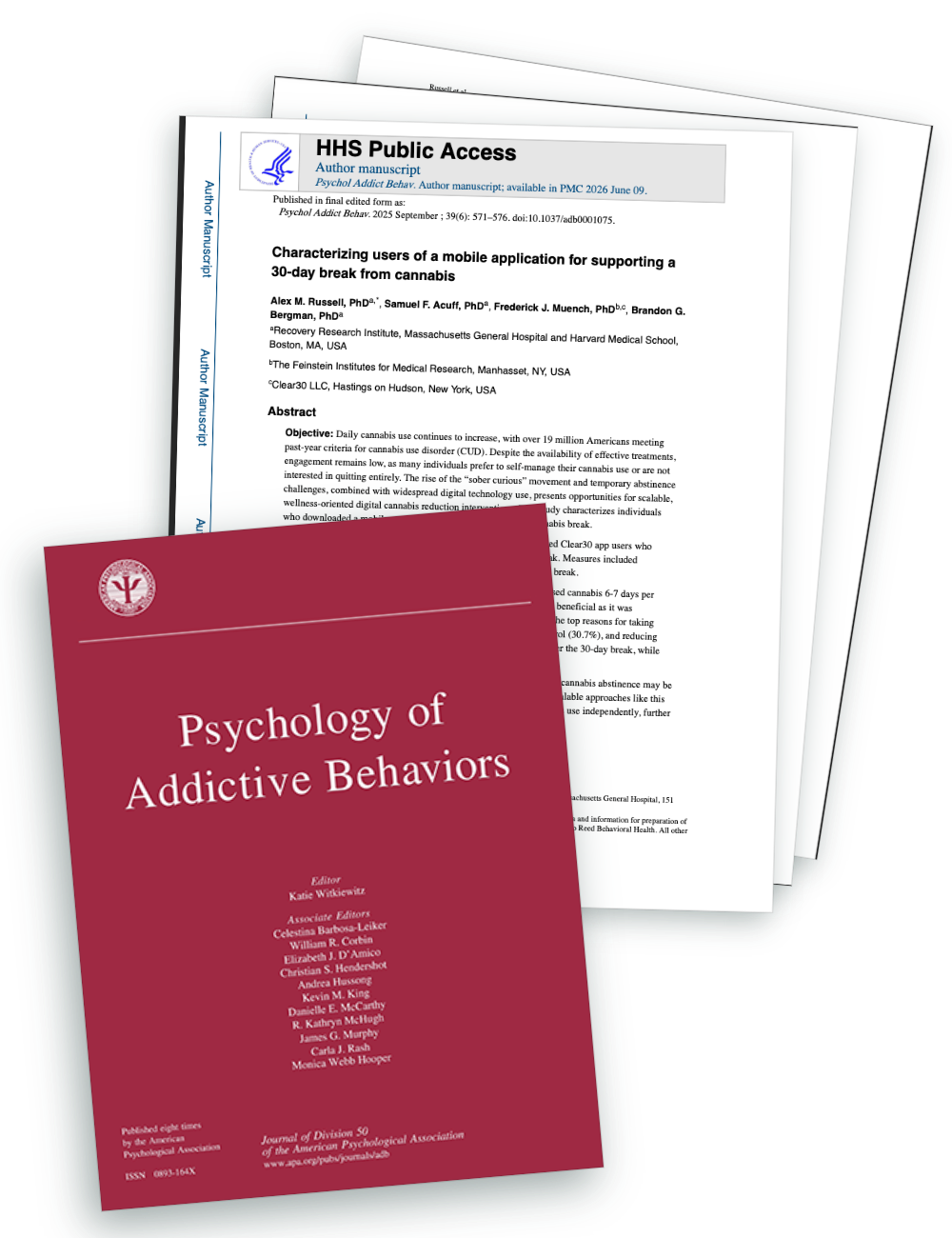
That collection is now one of the largest existing datasets on people who decided to change their cannabis use outside of any treatment system. The first peer-reviewed paper drawing on it was published in Psychology of Addictive Behaviors, a journal of the American Psychological Association, led by researchers at the Recovery Research Institute at Massachusetts General Hospital and Harvard Medical School.
“These are the people the field does not see. They use nearly every day, most of them do not think cannabis is hurting them, and they still want to stop for a month. If you only study people who walk into treatment, you never meet them and you never build anything for them.”
Dr. Fred Muench, co-founder and chief science officer, Clear30
Among those who had, 39.3 percent struggled and went back to using before they planned to, 30.0 percent found it challenging but mostly maintained the break, and 30.7 percent maintained it as intended.
Most people arriving have already tried this at least once. Short tolerance breaks are common in cannabis culture, and the existing research suggests longer, guided breaks produce better outcomes than brief unguided ones.
Asked about their goal after the thirty days, most wanted to use less or use differently rather than quit entirely. Together, 83.3 percent wanted to change something about their use.
Clear30 lets people choose their own goal at the start rather than assigning abstinence, which is what makes it usable by the majority of this group.
Then improving self-control and intention at 30.7 percent, reducing dependency at 26.2 percent, escaping feeling stuck in their own head at 23.4 percent, and reducing anxiety at 21.3 percent.
Physical health came in at 17.2 percent, lung health at 17.0 percent, depression at 16.8 percent, sleep quality at 14.8 percent and saving money at 12.3 percent. For this group the decision is largely a cognitive and emotional one.
The majority were between 18 and 20. Flower was the most common consumption method at 67.8 percent, followed closely by vapes at 63.7 percent, with edibles at 12.9 percent and dabs at 5.9 percent. Ninety-two percent were using the free version of the app.
Within that, 38.0 percent felt the effect was more positive than negative and 32.2 percent felt it was equally beneficial and harmful, while 25.7 percent saw it as more harmful than beneficial. They signed up for the break regardless, and 94.0 percent described themselves as at least somewhat committed to it, with 50.6 percent very committed.
The paper reads this as ambivalence rather than denial, and notes that working with ambivalence rather than arguing against it is a core principle of motivational interviewing. It also helps explain the appeal of a fixed 30-day break: it has a defined end, and it asks someone to gather evidence about their own use rather than accept a conclusion about it first.
The paper is a secondary analysis of de-identified data from people who downloaded Clear30 and completed the optional in-app baseline assessment between January and December 2024. After duplicate entries were removed, 4,415 unique users remained. Four assessment items were added partway through, so those were answered by 512 users, or 11.6 percent of the sample.
Clear30 provided the data. The analysis and the interpretation of results were carried out independently by the Recovery Research Institute team, a separation stated in the paper’s competing interests declaration.
The authors are explicit about what the paper does not do. It describes who arrives; it does not measure whether the break works. That is the next study, focused on whether Clear30 helps people reach their own goals around cannabis, underway with the same Recovery Research Institute team and expected in late 2026.

Medical School
General Hospital