
How to Do a T-Break: A Complete Guide
What a tolerance break is, why it works, and exactly how to plan one
Clear30 is the #1 science-based weed-break app. Join 150,000+ others resetting their relationship with cannabis and taking control of their focus, sleep, and mood.
A T-break — short for tolerance break — is a deliberate pause from cannabis that lets your body's endocannabinoid system reset. The payoff: the same amount of weed hits harder, costs less, and feels better than it has in months.
This guide walks you through exactly how to plan one — from picking the right length and prepping your environment, to handling the tough days, to coming back smart without rebuilding tolerance from scratch.
📋 How to Plan Your T-Break

How Long Should Your T-Break Be?
The right length depends on how often you've been using:
- Light users (a few times a month): Even a 48–72 hour break can produce noticeable results. Tolerance hasn't had time to build much.
- Moderate users (a few times a week): A 1–2 week break is the sweet spot. Receptors have time to recover meaningfully.
- Heavy or daily users: A 3–4 week break (like Clear30) is ideal. Research shows CB1 receptor density returns to near-baseline levels after about 4 weeks.
Individual factors — metabolism, body fat percentage, and the potency of what you were using — all influence how quickly your system resets. If you're also thinking about how long weed stays in your system for a drug test, note that the tolerance-reset timeline is much shorter than the THC-detection timeline.
When in doubt, longer breaks produce more significant results.
Signs You Actually Need a T-Break
Not sure it's time? Common indicators:
- You need significantly more cannabis to feel the effects you used to
- Your highs feel shorter, duller, or less enjoyable
- You're spending more money than you're comfortable with
- You feel foggy, unmotivated, or mentally sluggish throughout the day
- You've been using daily for an extended period without a break
- You feel anxious or uncomfortable at the thought of going without
- Cannabis has shifted from something you enjoy to something you feel you need
If multiple of these resonate — especially the last two — it's worth checking in on whether you're dealing with a tolerance issue or something further along the spectrum. Our self-assessment guide walks through the clinical criteria.
Preparing: Date, Space, Support
A little preparation dramatically changes how the break goes:
- Pick a clear start and end date. A defined timeline creates structure and accountability. Put it on your calendar.
- Remove temptation. Put cannabis, accessories, and paraphernalia out of sight — or give them to a trusted friend for the duration.
- Tell someone. Share your plan with a friend, partner, or family member. Accountability makes a real difference.
- Plan for triggers. Identify the situations, times of day, and emotions that usually make you want to use. Have alternative activities lined up in advance.
- Stock up on replacements. Herbal teas, CBD (if appropriate), workout gear, books, hobby supplies — something to fill the space cannabis used to occupy.
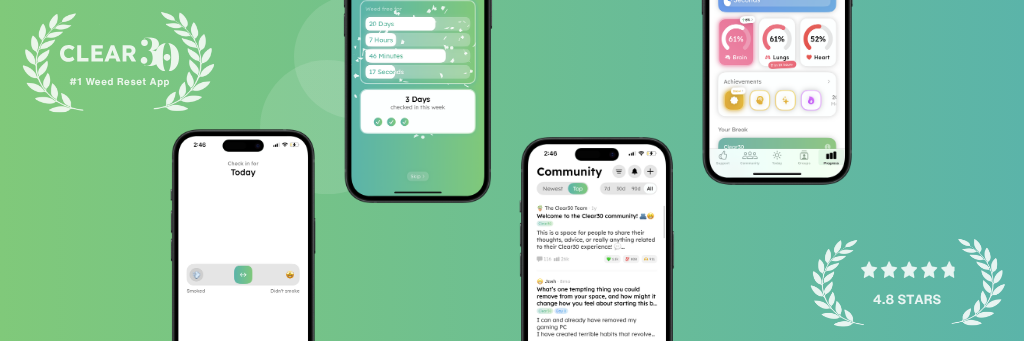
Tracking your break day-by-day is the single most reliable motivator. Clear30's break calendar gives you a visible streak that compounds — miss nothing for a week and you'll be surprised how much you don't want to lose the streak on day 8.
🗓️ The T-Break Experience

Common Challenges in the First Week
T-breaks aren't always easy — but the challenges are predictable, which makes them much easier to handle:
- Withdrawal symptoms: Irritability, anxiety, and mood swings are common in the first few days. Peak around days 3–5, then fade. See our full withdrawal symptom guide for what to expect by day.
- Sleep trouble: Many people rely on cannabis for sleep. Expect disrupted sleep the first week. See how to sleep without weed for specific tactics.
- Boredom: If cannabis was your default downtime activity, the first few evenings feel empty. Use the time to explore new interests or reconnect with old ones.
- Cravings: Normal and temporary. When one hits, remind yourself why you started. Our cravings guide covers the urge-surfing technique — observe the craving like a wave instead of fighting it until it passes.
A 13-year heavy user described day 3 of a T-break:I've been smoking heavily for 13 years. Longest I went without smoking is 2.5 days. I'm trying to take a break cause I feel like weed isn't helping my depression like it used to. But goddamn I'm on day 3 and I feel like s***. I've got a headache and honestly I can't stop thinking about getting high.— u/Ornery-Desk5444 on r/Petioles
Tips for Staying on Track
Once the break is underway, these make a real difference:
- Journal daily. Write about how you feel — the good, the bad, the unexpected. Tracking progress is motivating; you'll see how far you've come on day 14 even when day 14 feels mediocre.
- Exercise regularly. Physical activity releases endorphins that partly replace the mood-boost from cannabis. Even a 20-minute walk counts.
- Practice mindfulness. Sitting with discomfort instead of running from it is the whole skill here. Apps like Headspace or Insight Timer offer beginner-friendly sessions.
- Stay busy. Fill the time with activities that engage your mind and body. New hobbies, old hobbies, projects you've been putting off.
- Lean on community. r/Petioles and r/leaves are full of people who understand exactly what you're experiencing.
For in-the-moment cravings that feel like they're going to break you, Clear30's craving button drops you into a short guided response — built for the exact window (5–20 minutes) when most cravings peak and fade.
When It's Working: Signs the Reset Is Kicking In
Research shows that CB1 receptor availability begins increasing within just 2 days of abstinence, with the most significant recovery happening in the first 2–4 weeks.
You'll notice it in small ways before you notice it in big ways:
- Dreams come back (often vividly — your REM sleep is rebounding)
- Food tastes more vivid; you actually feel hungry rather than just eating out of habit
- Activities that felt flat start feeling rewarding again — walks, music, conversations
- Your mood settles into something more stable by week 2
- By week 3, most people notice they're thinking more clearly and sleeping more normally
After about 4 weeks, CB1 receptor density in most brain regions is comparable to non-users. Your endocannabinoid system is once again doing the job it was designed to do — regulating mood, appetite, sleep, and pain with its own natural chemistry.
A daily user describes coming back after a 3-week T-break:Yeah I smoke everyday pretty much but I took a 3 week break earlier this year. When I smoked again I got like uncomfortably stoned lol. It wasn't terrible, just a little weird for about 20 mins there, all good after that but it did surprise me.— u/MuhNamesTyler on r/trees
🔬 What a T-Break Is (The Science)

How Cannabis Tolerance Works
To understand T-breaks, it helps to know what tolerance actually is.
Your body has an endocannabinoid system — a network of receptors and neurotransmitters that regulates mood, appetite, sleep, pain, and more. The primary receptor THC interacts with is the CB1 receptor, found throughout the brain and nervous system.
THC mimics a naturally occurring neurotransmitter called anandamide — sometimes called the "bliss molecule" — that normally binds to CB1 receptors in small amounts and plays a role in mood and memory regulation. THC binds to the same receptors but much more powerfully than anandamide does.
With repeated exposure, your brain makes two adjustments:
- Downregulation: The brain reduces the number of available CB1 receptors on cell surfaces.
- Desensitization: The remaining receptors become less responsive to stimulation.
Net result: you need more cannabis to feel the same effects, and your body's own natural endocannabinoids have a harder time producing their normal signaling. That's tolerance in action.
Why It Resets: The 2-4 Week Recovery Window
The good news: these changes are reversible. CB1 receptors begin recovering within days of abstinence. Hirvonen et al. (2012), published in Molecular Psychiatry, used PET imaging to document this receptor recovery in chronic cannabis users — finding significant CB1 density restoration within the first 2-4 weeks of abstinence. NIDA's summary of long-term brain effects is consistent with this timeline.
After about 4 weeks, CB1 density in most brain regions returns to levels comparable to non-users. This is why the same dose that barely registered before a break can produce strong, satisfying effects afterward.
This receptor regeneration is also what drives the other benefits: better sleep, clearer cognition, restored appetite signaling, mood stabilization. Your endocannabinoid system is doing its own work again, not just responding to THC.
Why Bother — The Benefits
Several genuinely compelling reasons to take a tolerance break:
- Resetting your tolerance. The most obvious. Your CB1 receptors regenerate, so you feel the effects of cannabis more strongly with less product when you come back.
- Enhanced effects. Many users report that their first session after a T-break feels like the early days of using — more vivid, more euphoric, more enjoyable.
- Financial savings. Lower tolerance means you use less cannabis for the same effect. Real savings compound over months.
- Mental clarity. Breaks often lift brain fog, sharpen focus, and give you a clearer perspective on your relationship with cannabis.
- Assessing dependence. A T-break is a useful diagnostic. If it feels easy, great. If it's hard — that's information about your relationship with cannabis worth paying attention to.
🎯 After the Break: Coming Back Smart

Reintroducing Cannabis Mindfully
How you return matters just as much as the break itself:
- Start low, go slow. Your tolerance is significantly lower. Begin with half or even a quarter of your previous dose. Wait before redosing — the effects will feel stronger and come on faster than you remember.
- Pay attention. Notice how the cannabis hits. What do you actually enjoy? What feels different? Use this heightened awareness to inform your future habits.
- Set intentions before using. Ask why you're choosing to use right now. This keeps you from sliding back into unconscious, habitual consumption.
- Build in regular breaks. Many people find scheduling periodic T-breaks (one week a month, one month a quarter) maintains low tolerance long-term.
If you found the T-break harder than expected and are reconsidering your use more broadly, our taper vs. cold-turkey guide covers both extended-break approaches.
T-Breaks for Medical Cannabis Users
If you use cannabis for medical purposes, T-breaks require extra care:
- Consult your doctor first. Always talk to your healthcare provider before pausing medical cannabis. They can help plan a safe approach and manage any symptoms that return during the break.
- Consider CBD during the break. If you're breaking from THC specifically, CBD products may help manage symptoms without contributing to THC tolerance. CBD can provide anti-inflammatory, anti-anxiety, and pain-relieving benefits without the receptor downregulation THC causes.
- Try shorter breaks. For medical users, even a brief 2–3 day break can improve medication effectiveness. You don't necessarily need a full 30-day break to see benefits.
- Monitor your symptoms. Keep a log of how you feel during the break so you can discuss the results with your provider and adjust your treatment plan if needed.
Building T-Breaks Into Your Lifestyle
Regular T-breakers — recreational or medical — tend to have much healthier long-term relationships with cannabis than people who use continuously until it stops working.
A few patterns that work:
- One month on, one week off. Keeps tolerance from climbing into a place where you need a full reset.
- Quarterly deep breaks. One full 30-day break every 3 months resets receptors meaningfully while still fitting into a regular-use pattern.
- Seasonal breaks. Some people do an annual month off — often January or a specific month that lines up with other reset habits.
Whatever rhythm you pick, the key is scheduled — not "I'll take a break when I feel like it." Pre-committing is what makes it actually happen.
Clear30's break calendar and groups are built specifically for this pattern — visible streak, a community of people doing the same thing at the same time, and structured support for when you're tempted to skip day 23 of a 30-day reset.
Frequently Asked Questions
How long does THC stay in your system?
Can I use CBD during a T-break?
Do T-breaks actually work?
Will I experience withdrawal symptoms during a T-break?
How often should I take a T-break?
What if I can't make it through the full break?
Join the 30-day Clear30 Break and Reset Your Relationship with Weed
Clear30 is a science-backed, supportive way to take a 30-day break from cannabis. Our app gives you practical tools, daily guidance, and a community of people on the same journey.
- Claire — your 24/7 AI weed-break coach
- Daily break calendar & streak tracker
- Money-saved meter
- Groups with leaderboard + accountability pings
- Dedicated craving button & guided craving meditations
- Symptom cards for anxiety, sleep, cravings, and more
- Journal prompts and non-cannabis habit tracking
- Message a human peer expert
Whether you’re quitting, cutting back, or just taking a reset, Clear30 meets you where you are. Try the #1 science-based app to quit weed and compete in our 30-day break with others.
Ready to take a clear break from weed?
Start your 30-day break with Clear30 and reset your relationship with cannabis. You'll feel the difference. — The Clear30 Team
Download