

How to Sleep Without Weed
Overcoming Insomnia on a Tolerance Break
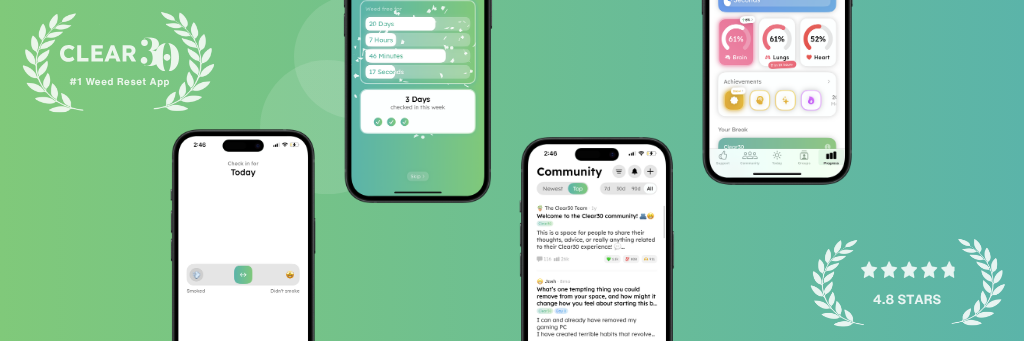
Clear30 is the #1 science-based weed-break app. Join 150,000+ others resetting their relationship with cannabis and taking control of their focus, sleep, and mood.
One of the most common challenges people face when taking a break from cannabis is difficulty sleeping. If you've relied on weed to fall asleep — whether for weeks, months, or years — your body has adapted to its presence, and removing it temporarily disrupts your natural sleep cycle.
The good news: this disruption is temporary, and there are concrete strategies that work. This guide covers why cannabis affects sleep the way it does, what to expect during the first few weeks, and the practical techniques (and tools) that help you get the rest you need — without weed.
🔬 Why Cannabis Affects Sleep (and Why It Gets Hard When You Stop)
How THC Hijacks Your Sleep Cycle
Cannabis, particularly THC, has well-known sedative properties. THC interacts with your brain's endocannabinoid system, promoting relaxation and drowsiness. For many people, this makes weed feel like the perfect sleep aid in the short term.
What THC does to a single night of sleep (drawing on the Angarita et al. 2016 review on cannabinoids and sleep in Addiction Science & Clinical Practice, a widely cited synthesis of what happens to sleep architecture during use and withdrawal):
- Reduces the time it takes to fall asleep
- Suppresses REM (Rapid Eye Movement) sleep — the dreaming stage
- Promotes deeper non-REM sleep early in the night
The catch is that REM sleep isn't optional. It's the stage your brain uses for memory consolidation, emotional processing, and cognitive restoration. Suppressing it night after night has costs that build up slowly.
Why Sleep Gets Worse Before It Gets Better
With regular use, your brain's natural sleep architecture gets remodeled around the presence of THC:
- Your body suppresses its own melatonin production and sleep-wake signaling
- You build tolerance — the same dose stops working the same way
- Sleep quality often declines over time, even though you may not realize it
When you stop, your brain has to rebuild those natural mechanisms from scratch. That rebuild is what causes the rough first week or two — and it includes a phenomenon called REM rebound, where your brain catches up on all the dreaming it missed. It's a normal sign that your sleep is recovering, even if it doesn't feel that way at 3 a.m.
😴 What Sleep Looks Like in the First Few Weeks
Common Sleep Challenges
Knowing what to expect helps reduce anxiety about the process. The most common patterns:
- Insomnia: Difficulty falling asleep or staying asleep is the most common complaint. Your brain is used to THC initiating the sleep process — without it, you may lie awake longer than usual.
- Vivid or disturbing dreams: When you stop using cannabis, REM sleep comes back with a vengeance. Dreams may be unusually intense, vivid, or even nightmarish. It's your brain catching up on dream sleep it's been missing.
- Night sweats: Some people experience sweating at night as their body adjusts to the absence of THC. This is part of normal cannabis withdrawal.
- Anxiety at bedtime: Without the relaxing effects of cannabis, racing thoughts and anxious feelings can be more noticeable when trying to fall asleep.
- Restlessness: Physical discomfort, tossing and turning, or an inability to get comfortable are common in the first week or two.
These symptoms typically peak within the first 3-7 days and gradually improve over the following 2-4 weeks as your sleep systems recalibrate.
One r/leaves user put the timeline bluntly:Took me about 3 weeks to get a solid 7-8. I was stringing together 4 hours here, 2 hours there. You're not going to improve your sleep by smoking you're only depriving yourself of solid REM sleep.— u/The_Nancinator75 on r/leaves
If those first-week nights are hitting hard, Clear30's symptom cards pair sleep, anxiety, and craving symptoms with quick, science-backed actions for the moment you need them.
Nightmares and Vivid Dreams (REM Rebound)
The surge of vivid dreaming after stopping cannabis — known as REM rebound — can be one of the most unsettling parts of a tolerance break. Here's how to manage it:
- Understand that it's normal. Your brain is making up for lost REM sleep. Vivid dreams, even disturbing ones, are a sign your sleep architecture is recovering. This phase is temporary.
- Keep a dream journal. Writing dreams down when you wake helps you process them and reduces their emotional weight. Over time you'll notice the intensity drops.
- Manage pre-sleep anxiety. Anxiety before bed fuels nightmares. Use relaxation techniques (see below), avoid scary or stressful content before sleep, and remind yourself that dreams cannot hurt you.
- Practice basic reality checks. If nightmares are frequent, simple lucid-dreaming techniques can help — throughout the day, ask yourself "Am I dreaming?" The habit can carry into your dreams and give you more awareness inside them.
- Give it time. For most people, REM-rebound dream intensity peaks in the first 1-2 weeks and gradually normalizes. Patience is the most underrated tool here.
One r/Dreams user described the REM rebound:I'm about 4 months post no THC (daily - heavy) and I still dream hard about 2-5 times a night depending on how much I am waking up. And each dream seems just as vivid.. remembering colors of shirts, conversations, you name it.. it's wild for sure. Sometimes they scare the s*** out of me because of how real they feel..— u/Ttot1025 on r/Dreams
🛏️ Building a Sleep Routine That Works Without Weed

Setting Up Your Sleep Environment
Your bedroom plays a bigger role than most people realize, especially during a tolerance break:
- Temperature: Keep your bedroom cool — ideally 60-67°F (15-19°C). A cool room promotes the natural drop in core body temperature that signals your brain it's time to sleep.
- Lighting: Make your room as dark as possible. Use blackout curtains or a sleep mask. Even small amounts of light from phones, alarm clocks, or streetlights can interfere with melatonin production.
- Noise: A white noise machine, fan, or earplugs can mask disturbances and promote deeper sleep.
- Bedding: Invest in a comfortable mattress and pillows. Your bed should feel like a place you want to be — not a source of physical discomfort.
- Scents: Lavender, chamomile, and cedarwood essential oils have been shown to promote relaxation. A few drops on your pillow or in a diffuser helps create a calming atmosphere.
Most importantly: reserve your bed for sleep only. Working, scrolling, or watching TV in bed weakens the mental association between your bed and falling asleep — and that association is exactly what you're trying to rebuild.
Daily Habits That Set Up Good Sleep
Beyond your environment, these habits dramatically improve sleep quality during a tolerance break:
- Maintain a consistent sleep schedule. Go to bed and wake up at the same time every day — even on weekends. Consistency reinforces your body's circadian rhythm and makes falling asleep easier over time.
- Limit screen time before bed. Blue light from phones, tablets, and computers suppresses melatonin. Aim to stop using screens at least 60-90 minutes before bedtime.
- Watch your diet. Avoid caffeine after 2 PM, and don't eat heavy meals close to bedtime. Light snacks like a banana, almonds, or warm milk contain natural tryptophan and magnesium that support sleep.
- Get sunlight during the day. Natural light, especially in the morning, regulates your circadian rhythm. Even 15-20 minutes outside can help.
- Exercise regularly, but not too late. Physical activity promotes better sleep, but intense exercise close to bed can be stimulating. Aim to finish workouts at least 3-4 hours before bed.
- Build a wind-down routine. Spend the last 30-60 minutes before bed doing calming activities: reading, gentle stretching, a warm bath, soft music. This signals your brain to transition.
Cravings can spike at the exact moments you're trying to wind down — that's when most people reach for weed in the first place. Knowing your triggers and patterns in advance makes those moments easier to ride out.
Tracking your sleep alongside your break in Clear30's break calendar gives you a visible streak — and on the harder nights, that streak is what keeps you from caving.
🧘 Tools for the Hard Nights

Natural Supplements That Can Help
Several supplements can support sleep during a tolerance break. Always check with a healthcare provider before starting anything new:
- Melatonin: A hormone your body naturally produces to regulate sleep. A low dose (0.5-3mg) taken 30-60 minutes before bed can help reset your sleep cycle. Start with the lowest effective dose — more isn't necessarily better.
- Magnesium: Supports muscle relaxation and nervous system regulation. Magnesium glycinate or threonate are forms often recommended for sleep. Typical dose: 200-400mg before bed.
- Herbal supplements: Valerian root, passionflower, and chamomile have a long history as sleep aids. Available as capsules, tinctures, or teas.
- L-Theanine: An amino acid in green tea that promotes relaxation without drowsiness. Helps calm racing thoughts at bedtime. Typical dose: 100-200mg.
Supplements work best when combined with good sleep hygiene — they're a complement to healthy habits, not a replacement.
Relaxation Techniques That Actually Work
When your mind is racing and sleep feels impossible, these techniques activate your parasympathetic nervous system — the body's "rest and digest" mode:
- 4-7-8 Breathing: Inhale through your nose for 4 seconds, hold for 7 seconds, exhale slowly through your mouth for 8 seconds. Repeat 3-4 cycles. Slows your heart rate and pulls your nervous system into a relaxed state.
- Progressive Muscle Relaxation (PMR): Starting from your toes and working up, tense each muscle group for 5-10 seconds, then release. The contrast between tension and release helps your body let go of physical stress.
- Guided imagery: Close your eyes and visualize a peaceful scene — a quiet beach, a forest path, a still lake. Engage all your senses. Redirects your mind away from anxious loops.
- Body scan meditation: Lie in bed and slowly bring your attention to each part of your body, from feet to head. Notice tension or sensation without trying to change it. Just observing your body can ease you into sleep.
If a craving hits in the middle of the night, Clear30's craving button and guided meditations walk you through a short reset designed for exactly that moment — without you having to think your way out alone.
Patience: Why Realistic Expectations Help You Sleep
The most important thing to remember: sleep difficulties during a tolerance break are temporary. Your body has spent weeks, months, or years relying on cannabis to initiate and maintain sleep. It's unrealistic to expect your natural sleep systems to bounce back overnight.
A general timeline of what to expect:
- Days 1-3: Worst sleep. Trouble falling asleep, frequent waking, sometimes barely sleeping at all. This is normal.
- Days 4-7: Slight improvement. Vivid dreams and some insomnia may persist.
- Weeks 2-3: Most people see significant improvement. Occasional restless nights, but falling asleep gets easier.
- Week 4+: Natural sleep patterns are largely restored — and for many people, sleep quality improves beyond what it was while using cannabis.
Be compassionate with yourself. Avoid clock-watching, catastrophizing about lost sleep, or reaching for cannabis as a quick fix. Each night — even the tough ones — moves you closer to the kind of restorative sleep your body is built for. Big changes take time, and sleep is one of the slowest systems to fully reset — but it does reset.
If sleep was a major reason you started questioning your cannabis use, you might also want to read our guide on recognizing the signs of cannabis dependence.
One last practical note: the single most common reason people relapse during a sleep-driven break is one bad night. When you've been awake until 3am three nights in a row, "just once to sleep" feels reasonable. It's the most predictable relapse trigger of all. If you know that going in, you can plan for it — have a pre-committed response ready for night 4 specifically, because that's the night that breaks most people.
Frequently Asked Questions
How long will insomnia last after I stop using weed?
Is it normal to have extremely vivid dreams?
Can I take melatonin to help me sleep during a tolerance break?
Will CBD help me sleep without affecting my T-break?
What if I still cannot sleep after several weeks?
Should I nap during the day if I did not sleep well?
Join the 30-day Clear30 Break and Reset Your Relationship with Weed
Clear30 is a science-backed, supportive way to take a 30-day break from cannabis. Our app gives you practical tools, daily guidance, and a community of people on the same journey.
- Claire — your 24/7 AI weed-break coach
- Daily break calendar & streak tracker
- Money-saved meter
- Groups with leaderboard + accountability pings
- Dedicated craving button & guided craving meditations
- Symptom cards for anxiety, sleep, cravings, and more
- Journal prompts and non-cannabis habit tracking
- Message a human peer expert
Whether you’re quitting, cutting back, or just taking a reset, Clear30 meets you where you are. Try the #1 science-based app to quit weed and compete in our 30-day break with others.
Ready to take a clear break from weed?
Start your 30-day break with Clear30 and reset your relationship with cannabis. You'll feel the difference. — The Clear30 Team
Download