
Getting Through Weed Cravings
Best Tools and Strategies
Clear30 is the #1 science-based weed-break app. Join 150,000+ others resetting their relationship with cannabis and taking control of their focus, sleep, and mood.
Cravings can feel like the boss level of your weed break. They show up uninvited, catch you off guard, and make you question why you started this in the first place. Here's the thing — cravings aren't your enemy. They're a sign that your brain is doing the hard work of rewiring around a change.
The goal isn't to avoid them — you can't. It's learning how to ride one out until it passes, and setting up your life so they get weaker over time. This guide covers why cravings happen, what to do when one hits, and how to build an environment where they stop running the show. Most individual cravings peak in 5-20 minutes and then fade, even when they feel like they won't — that single fact is the most important thing to know going in.
🔍 Why Cravings Happen

The Science Behind Cravings
Cravings happen because your brain is adjusting to life without cannabis. THC interacts with your endocannabinoid system, the system that regulates mood, appetite, and stress response. When you stop using, that system has to rebuild its natural signaling — and the intense urges are a side effect of that rebuild.
There's a second layer: your brain releases dopamine not just when you use cannabis, but when you anticipate using it. That anticipation loop keeps you in wanting-mode even when you're nowhere near actually smoking. Understanding the biology helps because it tells you the thing every ex-user eventually learns: cravings aren't a character flaw. They're a chemical pattern you can learn to navigate.
Emotional vs. Physical Cravings
Most cravings are a mix of both, but they come from different places:
- Physical cravings come from your body's adjustment to the absence of THC. They often travel with other cannabis withdrawal symptoms — restlessness, sleep trouble, agitation.
- Emotional cravings are triggered by feelings — stress, boredom, even nostalgia for the version of you that smoked. They're about your brain associating weed with comfort.
Knowing which one you're facing changes how you respond. Physical urges usually fade faster if you let your body move. Emotional urges need the underlying feeling named and processed, not just distracted from.
When Cravings Are Most Likely to Hit
Cravings rarely come out of nowhere — they cluster around predictable patterns:
- When you're stressed, overwhelmed, or under-slept
- At your usual smoking times (after work, before bed, Friday night)
- When you're around people, places, or media tied to the habit
- During transitions — coming home, finishing a task, starting something new
Writing down your personal pattern makes the next craving less surprising. Individual cravings peak in 5–20 minutes and then fade — though the overall pattern of having cravings tends to last several weeks before noticeably easing.
A useful in-the-moment tool: rate each craving on a 0–10 scale as you notice it.
- 0–3: Background noise. Usually passes on its own if you don't fixate on it.
- 4–6: Meaningful urge. Time to deploy a plan — move your body, change rooms, call someone.
- 7–10: Crisis-level urge. Pull out the bigger tools — craving button, breathing, leave the environment, text support.
Most cravings live in the 4–6 range. Very few actually reach 9–10. Naming the intensity gives you something concrete to respond to instead of feeling consumed.
One r/leaves user described when cravings hit hardest:As far as cravings go, I'm at 7 months, still have cravings, however they are maybe only once a day and are easier to ignore. I noticed I don't have cravings at work or when I'm on my bicycle, or if I'm exhausted. So keeping your mind and body stimulated is key, easier said than done. My days off trying to relax are hell.— u/Valuable_Impact4950 on r/leaves
🔄 How to Think About Cravings Differently
Cravings Are a Sign of Progress
Here's a mindset shift that actually helps: cravings aren't proof you're failing. They're proof your brain is rewiring. Every urge you feel is a moment where the old neural path got activated — and every time you don't act on it, that path gets slightly weaker and the new one gets slightly stronger.
This process has a name neuroscientists use: extinction learning. When a behavior (smoking) is no longer paired with its usual reward (the THC high), your brain gradually updates its expectations. The craving doesn't disappear instantly — but each refused urge is a data point telling your brain the old prediction was wrong. Over weeks, those data points accumulate. The craving signal gets weaker because your brain learns it's not leading anywhere useful.
Lifting the same weight every day doesn't feel good in the moment either. But the muscle still grows — even on the days you can barely finish the set.
Turning Struggle Into Strength
The discomfort you feel during a craving is temporary. The thing you're building by riding through it — the evidence that you CAN sit with discomfort without using — lasts much longer.
One helpful reframe from r/ElderTrees is talking to yourself in the language of your new identity: "Why am I having a craving? I don't smoke anymore." Feels silly the first time. Cuts off the internal tug-of-war surprisingly fast.
One r/leaves user shared what replaced the cravings:reading and self care in general, my house is cleaner I always have food prepped for the week, I call my family more often, I replaced my weed addiction with life. Don't overthink this just start living without pot.— u/fairyripper90 on r/leaves
🛠️ What to Do When a Craving Hits

Identify Your Triggers
Most cravings are trigger-based. Name the pattern and you can prepare for it:
- Common triggers: stress, boredom, specific people, music, smells, times of day
- Avoidance tactics: change the routine around the trigger, politely decline invitations where weed will be present, keep paraphernalia out of your living space
- Replacement tactics: when the trigger hits, have a pre-decided alternative already lined up (a walk, water, a phone call) so you're not inventing one mid-urge
Your environment is the single biggest multiplier on how often cravings hit. Setting it up right is 80% of the work.
Distract and Redirect
Cravings typically peak in 5–20 minutes and then fade. The job is getting through that window without using:
- Move your body — even a 10-minute walk changes your brain chemistry enough to soften the urge
- Change locations — get out of whatever room you're in
- Call someone — anyone, about anything
- Dive into a hobby — something that occupies your hands and attention
- Replace the ritual: if rolling a joint was part of your wind-down, brew a tea or light a candle instead
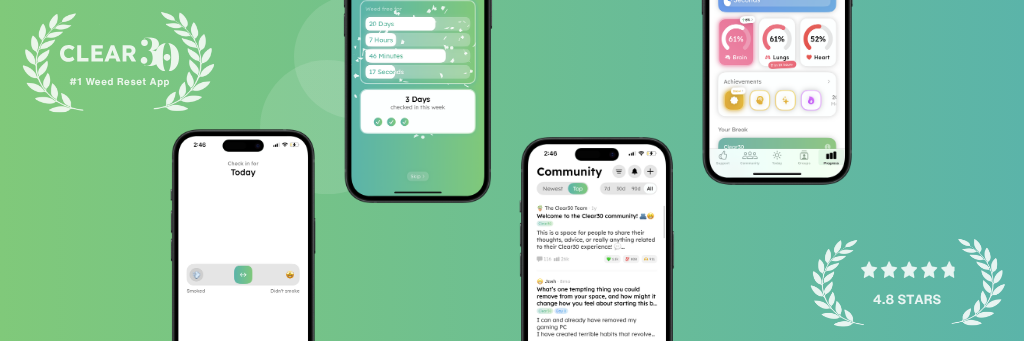
Clear30's craving button is built for this exact window. One tap drops you straight into a short guided response — no menus, no willpower coin-flip at the moment you have the least willpower.
Urge Surfing: Ride the Craving Instead of Fighting It
One of the most effective techniques for managing cravings has a name: urge surfing. It comes from clinical psychologist Alan Marlatt's research on mindfulness-based relapse prevention, later developed into MBRP (mindfulness-based relapse prevention), a protocol with strong evidence across substance use disorders. The idea is counterintuitive: instead of fighting a craving (which tends to amplify it) or white-knuckling through (which exhausts you), you observe it like a wave.
Here's how it works in practice:
- Notice the craving without judgment. Name it plainly: "I'm having a craving." Don't moralize about having it. Don't scold yourself. Just acknowledge it's there.
- Locate it in your body. Is there tension in your chest? A pull in your stomach? A tightness in your jaw? Moving your attention to the physical sensation pulls you out of the thought-loop about the craving and into observation mode.
- Watch the wave. Cravings rise, crest, and fall — rarely longer than 20 minutes, usually much shorter. Your only job is to not act until it's passed.
- Breathe through the peak. Slow, deliberate breaths keep you anchored while the intensity moves through you.
Urge surfing isn't about making cravings stop — it's about removing the fight that makes them worse. Most people who try it once are surprised by how quickly the urge loses power when it's not being resisted or indulged. It's one of the core techniques taught in mindfulness-based relapse prevention programs across addiction treatment.
Breathing, Mindfulness, and Journaling
When the craving is more emotional than physical, breathing and reflection work better than pure distraction:
- Box breathing: 4 seconds in, 4 hold, 4 out, 4 hold. Repeat 4 cycles. Shifts your nervous system out of urge mode.
- Mindfulness: notice the craving like weather — it's here, it's uncomfortable, and it's not permanent. You don't have to fight it to survive it.
- Journaling: write out what you were feeling right before the craving hit. Almost always uncovers the real feeling underneath.
Common Mistakes People Make with Cravings
Five patterns that make cravings harder than they need to be — and what to do instead:
- Fighting the craving with willpower alone. White-knuckling tends to amplify urges. Urge surfing (observe without acting) works better. If you've already exhausted willpower by the time cravings hit, you're in trouble.
- Treating every craving as a crisis. Most cravings are 4s or 5s on the 0–10 scale. Not every one needs the full crisis response. Save that for the actual spikes.
- Avoiding all triggers forever. Short-term avoidance helps; permanent avoidance doesn't. You have to eventually learn to exist in your normal environment without using. Graduated re-exposure works better than hiding.
- Using a past craving as evidence that it'll never end. Individual cravings last 5–20 minutes; the overall pattern of having cravings eases meaningfully over 2–3 weeks. Don't extrapolate from today's worst craving.
- White-knuckling instead of asking for help. A 30-second call to a friend outperforms an hour of solo willpower. Don't treat needing help as weakness — it's the most reliable tool you have.
🏗️ Building a Life Where Cravings Get Weaker

Setting Up Your Environment
Sometimes the best craving management is prevention:
- Physical space: clear out paraphernalia, smell residue, and visual cues. Out of sight really does reduce cue-triggered urges — your brain responds to those reminders before you consciously register them.
- Digital space: unfollow accounts that glorify cannabis, mute hashtags, and delete apps that connect you to dealers or old smoking friends. Fill the feed instead with content about the life you want to build.
Getting Support
You don't have to do this alone:
- Tell friends and family — the ones who respect your goals will rise to meet them
- Find community — whether that's r/leaves, Marijuana Anonymous, or a private crew of people on the same path
- Revisit your why — write it down, keep it somewhere visible, re-read it when cravings hit
Some users on r/recovery share their personal craving timelines — most describe cravings dropping noticeably after 2-3 weeks of consistent non-use.
If you want that kind of accountability built into your day, Clear30's groups and community put you in a crew going through the same thing at the same time.
When a Slip Happens
Slips are part of change for most people. If one happens:
- Don't treat one slip as "it's over." That's the spiral that turns a slip into a full relapse.
- Look at what triggered it — stress, a social situation, a specific feeling — and use that as data for next time.
- Get back on the break the same day if possible. The longer you wait, the harder the restart.
Our guide on dealing with setbacks goes deeper on this. The goal isn't a perfect streak — it's a durable relationship with cannabis that you actually want. Cravings may knock on your door, but they don't get to move in unless you let them.
Frequently Asked Questions
What should I do if a craving feels overwhelming?
Are there supplements that help reduce cravings?
How long do cannabis cravings usually last?
Can I train my brain to stop cravings altogether?
What if my environment isn't fully supportive?
When should I seek help for persistent cravings?
Join the 30-day Clear30 Break and Reset Your Relationship with Weed
Clear30 is a science-backed, supportive way to take a 30-day break from cannabis. Our app gives you practical tools, daily guidance, and a community of people on the same journey.
- Claire — your 24/7 AI weed-break coach
- Daily break calendar & streak tracker
- Money-saved meter
- Groups with leaderboard + accountability pings
- Dedicated craving button & guided craving meditations
- Symptom cards for anxiety, sleep, cravings, and more
- Journal prompts and non-cannabis habit tracking
- Message a human peer expert
Whether you’re quitting, cutting back, or just taking a reset, Clear30 meets you where you are. Try the #1 science-based app to quit weed and compete in our 30-day break with others.
Ready to take a clear break from weed?
Start your 30-day break with Clear30 and reset your relationship with cannabis. You'll feel the difference. — The Clear30 Team
Download