
Should I Quit Weed or Moderate?
How to honestly decide between cutting back and stopping entirely
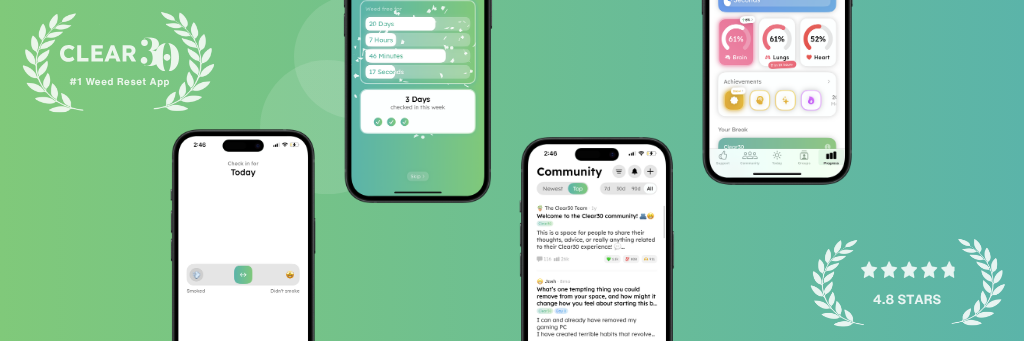
Clear30 is the #1 science-based weed-break app. Join 150,000+ others resetting their relationship with cannabis and taking control of their focus, sleep, and mood.
Deciding whether to stop cannabis entirely or learn to moderate is deeply personal — there's no universal right answer. What matters is finding the approach that actually works for your life, your goals, and your current relationship with weed.
This guide walks through how to honestly assess where you are, which approach fits which type of user, and — if you're on the fence — a framework to help you decide without having to commit forever.
🔍 First, Honestly Assess Your Relationship with Cannabis

Questions to Ask Yourself
Before picking an approach, the question worth sitting with is: what is cannabis actually doing for you right now? Ask yourself honestly:
- Why do I use cannabis? Is it for relaxation, creativity, social enjoyment — or to manage stress, pain, or difficult emotions?
- Has my use increased over time?
- Am I able to take breaks without significant discomfort?
- Is my cannabis use affecting my work, relationships, or health?
- Do I feel like I'm in control of my use, or does it feel like it's in control of me?
If any of these hit a nerve, our self-assessment guide walks through clinical criteria (based on the DSM-5 Cannabis Use Disorder framework) that can help you place where you are on the spectrum.
What "Moderate" vs "Quit" Actually Mean
The two paths look very different in practice:
- Moderation means continuing to use cannabis but with real, maintained boundaries — around when, how much, and why. Not "I'll cut back," but specific rules you actually stick to: weekends only, or a max amount per month, or only after 8pm.
- Quitting means stopping entirely, at least for a defined period. For many people, a 30-day break is where they start before deciding whether to stay off or return to moderate use.
Both paths are legitimate. The mistake people make isn't picking wrong — it's picking one then half-committing, which tends to produce the worst outcome of either approach.
⚖️ When Moderation Might Work for You

Signs Moderation Is Likely Enough
Moderation is more likely to work if:
- You can go several days without cannabis without significant discomfort or cravings
- You've successfully set and maintained boundaries with other substances or habits in the past (you drink moderately, you control screen time, etc.)
- Your cannabis use hasn't caused major problems in relationships, work, or health
- You use primarily for enjoyment rather than to escape or self-medicate
- You have a clear idea of what "moderate" means for you specifically — not just "less"
The last point is the one most people miss. If you can't define moderation before you start, you won't know whether you're doing it.
How to Actually Moderate (Not Just Say You Will)
The difference between successful moderation and a slow return to heavy use usually comes down to pre-commitment. Specific tactics:
- Define your rules in advance. Exactly how many sessions per week? What size? What time of day? Written down, not just in your head.
- Pair use with an intentional trigger, not a default. "Only after exercise," or "only on Saturday night with friends," works better than "whenever I feel like it."
- Keep paraphernalia out of reach. Sounds small, but the more friction between you and the next session, the better moderation sticks.
- Track honestly. Keep a simple log — how many sessions this week, how you felt. Seeing the data catches drift before it becomes a habit.
- Build in periodic breaks. Regular t-breaks — see our t-break guide — prevent tolerance creep that often sabotages moderation over time.
If you want structured check-ins during a moderation attempt, Clear30's groups and community can provide that accountability — people doing the same thing, visible streaks, no judgment when you drift.
One r/leaves user on how moderation attempts usually go:For most chronic smokers who quit, it's very difficult to just "smoke occasionally". Tread lightly! My wife and I quit for two months, went out for a fancy dinner for our anniversary and said "let's just get one joint to enjoy the night, next thing you know we were back to smoking everyday.— u/tigercatwoof on r/leaves
Common Moderation Traps to Watch For
A few patterns reliably convert moderation attempts back into heavy use. Knowing them in advance makes them easier to catch:
- The "rough week" exception. Your rules hold in normal weeks and collapse under any real stress. If your moderation only works when life is easy, it's not actually working.
- Slow rule creep. "Weekends only" quietly becomes "weekends plus one weeknight." Track in writing; don't rely on memory.
- Social auto-pilot. "Only if someone else is smoking" sounds harmless but outsources your rule to whoever's in the room. Pre-decide how you'll respond to social offers.
- The potency trap. Cutting frequency while increasing what you use per session (higher-THC products, dabs) isn't moderation — tolerance keeps climbing. Moderation has to include dose, not just timing.
- Justifying resets as "just this once." Everyone relapses occasionally. The risk is treating each reset as invisible instead of updating your rules based on what you learned.
If two or more of these are happening, the honest move is usually to pause moderation and do a 30-day break first to reset tolerance and decision-making baseline.
🚪 When Quitting May Be the Better Path

Signs Quitting Is the Right Call
Quitting entirely may be the better path if:
- You've tried moderating multiple times and consistently end up back at heavy use
- You use cannabis to cope with negative emotions — stress, anxiety, sadness, loneliness
- Your use has caused problems at work, in relationships, or with your health
- You feel anxious, irritable, or unable to function normally without it
- Thinking about moderation feels more like negotiation than planning — "only 3 times a week" that quietly becomes 5, then daily again
- The relationship has moved from "I enjoy cannabis" to "I need cannabis"
If several of these resonate, you may be dealing with Cannabis Use Disorder rather than a moderation challenge. That's not a character judgment — it's a clinical distinction that changes which approach is likely to work.
How to Know If Moderation Has Already Failed
A pattern a lot of people recognize in retrospect: moderation that's actually just reduced heavy use, not truly moderate use. Some honest signals:
- You've set "this is the last time I'll go back to daily" multiple times
- Your "moderation" rules keep getting renegotiated upward
- Stressful weeks automatically mean more cannabis — your rules collapse under any real pressure
- You find yourself hiding how much you use from your partner, friends, or doctor
- The idea of a full 30-day break feels more threatening than the idea of "just cutting back"
That last one is diagnostic. If the thought of 30 days off genuinely feels impossible, that's usually the clearest indicator that a break — not moderation — is what's actually needed.
One r/leaves user put the realization directly:I learned I can't live in moderation with weed, I either smoke all day everyday or completely cut it out of my life. Also learned that I can't allow myself to "smoke just once and stop". It doesn't work for me.— u/Coolersami on r/leaves
How to Actually Stop (If That's the Call)
If you decide to stop — whether for 30 days or longer — a few things dramatically improve your chances:
- Pick a specific start date and an initial end date (even if you extend later)
- Decide in advance between tapering off vs. cold turkey based on how heavy your use has been
- Know what to expect during the first two weeks of withdrawal so day 3–5 doesn't catch you off guard
- Have a plan for cravings — specifically, what you'll do in the first 20 minutes when one hits
- Set up your environment and support system before day 1 (see the t-break guide's "Preparing" section)
For structured day-by-day support through the hardest first month, Clear30's break calendar and guided daily check-ins are built for this exact window.
🎯 The Decision Framework (If You're Still On the Fence)
The Science: Why Some People Can Moderate and Others Can't
Not everyone is equally able to moderate — and the reasons are partly biological.
THC activates your brain's reward circuit by triggering dopamine release through the endocannabinoid system. Over time, with regular heavy use, your brain adapts:
- Tolerance: CB1 receptors downregulate, so more cannabis is needed for the same effect
- Baseline dopamine drops: Things that used to feel rewarding feel flat without THC
- Dependence develops: Your brain starts relying on THC to maintain normal mood and function
People who've reached the dependence stage have a significantly harder time moderating — not because of willpower, but because their brain's reward system has been rewired. About 9% of cannabis users develop dependence, and the number climbs to 17% for people who start in adolescence.
Dependence vs. addiction — why the distinction matters here: Cannabis dependence (physical + psychological reliance that causes withdrawal) is different from addiction (compulsive use despite negative consequences). You can be dependent without being addicted — many daily users fall in this middle space. Moderation is often viable for dependent users who haven't crossed into compulsive use. For people who have crossed that line, moderation tends to fail because the decision-making part of the brain (the prefrontal cortex) has been trained to prioritize the short-term reward over long-term rules. A break gives that system time to recalibrate before you ask it to do precision decision-making.
The practical implication: if you've been using daily for years and moderation keeps failing, it's not a motivation problem. It's a neurobiology problem that typically needs a reset (a break) before moderation becomes realistic.
A Simple Decision Framework
If you're genuinely unsure, here's how most people find their answer:
- Start with a 30-day break. Commit to the full month. This gives you a clean baseline — you'll learn more about your actual relationship with cannabis in 30 days than in years of trying to moderate.
- Pay attention to what shifts. Sleep, mood, motivation, finances, relationships. Keep a simple daily log.
- Notice how you feel about returning. If you reach day 30 and feel clearer, don't miss it, and want to keep going — that's a signal. If you've been counting the hours, that's a different signal.
- Decide from the cleared baseline. After 30 days, you can return to cannabis with intentional, pre-committed rules (moderation), stay off entirely, or extend the break. Whichever you choose, you're deciding from a real baseline rather than from inside the haze.
The framework works because it doesn't force a permanent decision. 30 days is time-bounded, reversible, and — per t-break research — enough time for your endocannabinoid system to largely reset. You'll know more about yourself on day 30 than you did on day 1, and from that knowledge you can make a durable choice.
One practical note: if you hit day 30 and it clearly feels better, the natural next step is extending to 60 or 90 days rather than returning. Each additional month continues the endocannabinoid recalibration — and many people find that what felt like ambivalence at day 30 resolves into real clarity by day 60.
Tools and Support (Whatever You Choose)
Whatever path you pick, a few resources make it easier:
- Clear30: Our 30-day program provides daily guidance, community support, and tracking — whether you're quitting, resetting before moderation, or just experimenting with a break.
- Online communities: r/leaves (people quitting) and r/Petioles (people moderating) are both active communities where you can learn from others on the same path.
- Therapy: Cognitive Behavioral Therapy (CBT) and Motivational Enhancement Therapy (MET) are evidence-based for cannabis use disorder. Most insurance covers it; telehealth options make access easier than ever.
- If moderation or breaks have repeatedly failed, our guide on dealing with setbacks walks through how to reset without the shame spiral.
Frequently Asked Questions
Is it easier to quit weed entirely or cut back?
How do I know if I can moderate my cannabis use?
What if I try to moderate and fail?
Do I need to quit entirely if I only use cannabis socially?
Will I experience withdrawal if I only cut back?
How long does it take to decide which approach is right for me?
Join the 30-day Clear30 Break and Reset Your Relationship with Weed
Clear30 is a science-backed, supportive way to take a 30-day break from cannabis. Our app gives you practical tools, daily guidance, and a community of people on the same journey.
- Claire — your 24/7 AI weed-break coach
- Daily break calendar & streak tracker
- Money-saved meter
- Groups with leaderboard + accountability pings
- Dedicated craving button & guided craving meditations
- Symptom cards for anxiety, sleep, cravings, and more
- Journal prompts and non-cannabis habit tracking
- Message a human peer expert
Whether you’re quitting, cutting back, or just taking a reset, Clear30 meets you where you are. Try the #1 science-based app to quit weed and compete in our 30-day break with others.
Ready to take a clear break from weed?
Start your 30-day break with Clear30 and reset your relationship with cannabis. You'll feel the difference. — The Clear30 Team
Download