
Cannabis Use Disorder (CUD): What It Is and How to Know If You Have It
The clinical framework behind problem cannabis use — and what the diagnosis actually means
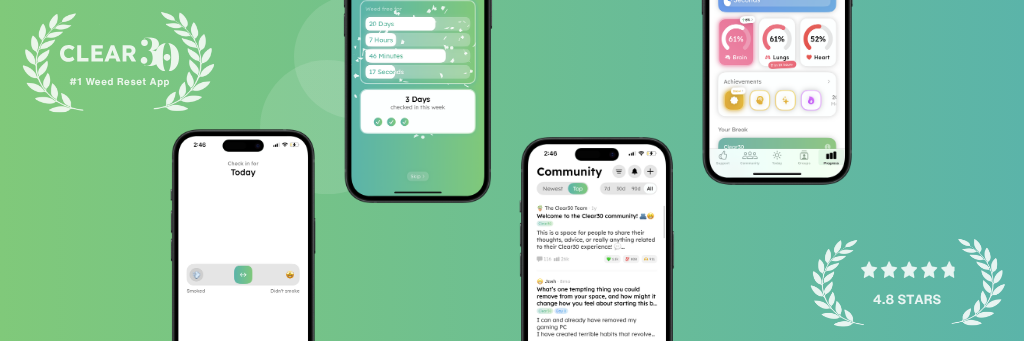
Clear30 is the #1 science-based weed-break app. Join 150,000+ others resetting their relationship with cannabis and taking control of their focus, sleep, and mood.
Cannabis Use Disorder (CUD) is the clinical term for problem cannabis use. It's recognized in the DSM-5 — the diagnostic manual psychiatrists and therapists use — and it's diagnosed along a spectrum from mild to severe, based on how many specific criteria you meet.
If you've ever wondered whether your cannabis use has crossed from habit into something clinical, or if a doctor has mentioned CUD to you, this guide walks through what the diagnosis actually means: the 11 official criteria, how severity is determined, who’s at risk, and what to do next. CUD is not a character judgment — it's a descriptive medical category with defined treatment paths.
📋 What Cannabis Use Disorder Actually Is

The Clinical Definition
Cannabis Use Disorder is defined in the DSM-5 (Diagnostic and Statistical Manual of Mental Disorders, 5th edition) as "a problematic pattern of cannabis use leading to clinically significant impairment or distress."
In plainer terms: it's diagnosed when someone's cannabis use is actively causing measurable harm to their life — health, relationships, work, or psychological functioning — and they keep using despite that harm.
Two key things to understand up front:
- CUD exists on a spectrum. It ranges from mild (2–3 criteria met) to moderate (4–5) to severe (6+). Most people with problem cannabis use fall in the mild-to-moderate range.
- Dependence is not the same as CUD. Physical dependence (withdrawal on stopping) is one possible criterion, but CUD is a broader pattern including behavioral, psychological, and social factors. You can be dependent without meeting full CUD criteria, and vice versa.
How Common Is It?
More common than most people realize, especially with the rise of high-potency cannabis products:
- About 9% of adult cannabis users develop CUD at some point (per Hasin et al., JAMA Psychiatry 2015, which established the DSM-5-based prevalence estimates).
- About 17% of people who start using as adolescents develop CUD.
- About 25–50% of daily users meet CUD criteria in any given year.
These numbers have climbed since legalization expanded access and potency jumped — concentrate use (dabs, high-THC carts) accelerates the path from casual use to CUD.
The reason many people don't recognize CUD in themselves: the term "addiction" has heavy cultural associations (rock bottom, losing jobs, crime) that most CUD cases don't match. CUD can look like a high-functioning daily user who hides how much they smoke, struggles to take breaks, and quietly structures their life around cannabis. Many people diagnosed with CUD have steady jobs, intact relationships, and no external signs of a problem — which is part of why it so often goes unrecognized and untreated for years.
🩺 The 11 DSM-5 Criteria (And How Severity Is Determined)

The Full Diagnostic List
A clinician diagnoses CUD by evaluating whether these 11 criteria apply to someone's cannabis use in the past 12 months:
- Using more or longer than intended. You meant to have a couple puffs before bed; you smoked for two hours and scrolled until 2am. Happens regularly.
- Persistent desire or unsuccessful attempts to cut down. You've tried "only on weekends" or "only after 5pm" multiple times and the rules kept collapsing.
- A lot of time spent obtaining, using, or recovering from cannabis. Getting high, being high, and dealing with the comedown take up meaningful chunks of your day — including planning when you'll next use.
- Strong cravings or urges to use. Intrusive wanting, not just enjoying — the difference between "I'd like some weed" and "I can't stop thinking about weed."
- Failure to fulfill major obligations at work, school, or home because of cannabis use. Missing deadlines, showing up impaired, blowing off responsibilities.
- Continued use despite social or interpersonal problems caused or worsened by cannabis — partner arguments about it, friends pulling away, family concerned, but you keep using.
- Giving up important activities (hobbies, exercise, social events) because of cannabis. The hobby that used to feel fun got replaced by "why don't I just smoke instead."
- Using in physically hazardous situations — driving high, operating machinery, working a job where impairment creates safety risk.
- Continued use despite knowing it's causing physical or psychological harm — you know your sleep, anxiety, or cognitive function is worse, and you keep using anyway.
- Tolerance — needing significantly more cannabis to get the same effect, or feeling much less effect from the same amount. Your "one-hitter" became a full bowl; your edibles dose keeps climbing.
- Withdrawal — experiencing symptoms when you stop (irritability, sleep disruption, anxiety, appetite loss), or using cannabis to avoid those symptoms.
Meeting 2–3 of these = mild CUD. 4–5 = moderate. 6 or more = severe.
If you recognize yourself here, our self-assessment guide walks through these criteria in more detail with a practical scoring framework.
One r/leaves user on naming the pattern and confronting it:My partner introduced me to weed and has encouraged me these past 2 years to use. We had a series of long conversations about how it affects us, the effect on my mental health, the effect on our kid, the effect on motor skills, memory, motivation, energy levels. I basically told him it's our family or the weed. I said it's damaging our health because we are using at levels it ISN'T HEALTHY. Like I fully admitted to him sure, weed can be healthy. When it's responsible use. Smoking daily, multiple times a day, isn't responsible.— u/aggy-scouse-bird on r/leaves
Why the Severity Spectrum Matters
CUD severity isn't just a clinical label — it predicts which treatment approaches tend to work:
- Mild CUD: Often resolvable with lifestyle change alone. Structured breaks, environmental changes, and self-directed quitting often work.
- Moderate CUD: Typically benefits from structured support — therapy, peer groups, or apps designed specifically for this. Quitting on willpower alone works for some but fails more often than in mild cases.
- Severe CUD: Usually needs professional support. Therapy (CBT, Motivational Enhancement), sometimes medication for co-occurring conditions, and possibly residential treatment in extreme cases.
Severity can also change over time — people move from mild into moderate as use escalates, or from moderate back to mild as they develop coping strategies.
🧬 Who Develops CUD — and Why
Risk Factors
CUD doesn't develop randomly. The strongest predictors:
- Early onset of use. Starting in adolescence (before age 18) roughly doubles lifetime CUD risk. The teenage brain is more susceptible to rewiring around THC.
- Frequency and duration. Daily use for years dramatically increases risk. Occasional weekend use rarely escalates to CUD.
- High-potency products. Research shows that high-THC concentrates (dabs, concentrates, high-THC carts) accelerate tolerance and dependence compared to lower-potency flower.
- Family history of substance use disorders. There's a hereditary component — if close family members have struggled with any substance, your risk is higher.
- Co-occurring mental health conditions. Anxiety disorders, depression, ADHD, PTSD, and bipolar disorder all correlate with higher CUD risk — partly because cannabis is often used to self-medicate these conditions.
- Trauma history. Childhood adverse experiences, abuse, or neglect raise the risk of developing any substance use disorder.
Why Cannabis Specifically
There's a common misconception that cannabis is "non-addictive" because it lacks the dramatic withdrawal profile of alcohol or opioids. That framing is outdated.
Cannabis affects the brain's reward system through the endocannabinoid system. With regular heavy use, the brain downregulates its CB1 receptors — which changes how dopamine signaling works across several brain regions involved in motivation, reward, and decision-making.
The result: some people develop strong psychological dependence even without the dramatic physical withdrawal of other substances. They're not in medical danger, but they're still in a compulsive pattern that's hard to break.
That's why CUD deserves to be recognized alongside other substance use disorders, even though it looks different on the surface.
🎯 What to Do If You Meet the Criteria

First: Don't Panic About the Label
Reading the criteria and seeing yourself in several of them can feel alarming. Keep this in mind:
- Mild CUD is common and manageable. If you meet 2–3 criteria, you're in the same bucket as roughly a quarter of daily cannabis users.
- The label is informational, not fatal. It tells you about your current relationship with cannabis. It doesn't predict anything about your future if you change the pattern.
- CUD is one of the most responsive substance use disorders. Outcomes for people who engage with treatment (of any kind) are substantially better than doing nothing.
The right response isn't shame — it's getting informed about what intervention level fits your severity.
Treatment Options by Severity
What tends to work, tiered by severity:
Mild CUD (2–3 criteria):
- Start with a structured break — 30 days minimum. See how to do a t-break.
- Address environmental triggers — who, where, when you use.
- If willpower alone isn't enough, a structured program (like Clear30) or peer community provides scaffolding.
- Periodic self-check-ins against the criteria list to track improvement.
Moderate CUD (4–5 criteria):
- Consider talking to a therapist experienced with substance use. CBT and Motivational Enhancement Therapy have the strongest evidence for cannabis specifically.
- Combine therapy with a structured break — don't rely on one without the other. Our taper vs. cold-turkey guide covers the approach choice.
- Join a peer group (Marijuana Anonymous, SMART Recovery, online communities) for accountability.
- Address co-occurring conditions (anxiety, depression, sleep issues) simultaneously — they'll undermine quit attempts if left untreated.
Severe CUD (6+ criteria):
- Professional treatment is generally the most effective path. Intensive outpatient programs (IOP), residential treatment, or weekly therapy with medication support for co-occurring conditions.
- If there's been physical health impact (weight loss, chronic vomiting, psychosis), medical evaluation is important.
- If you've developed cannabinoid hyperemesis syndrome, complete cessation is non-negotiable and should be medically supervised.
What to Expect in Therapy for CUD
If you're considering therapy but haven't done it before, here's what treatment for CUD actually looks like:
The modalities with the strongest evidence:
- Cognitive Behavioral Therapy (CBT): The workhorse approach. You identify trigger situations, underlying beliefs that drive using, and alternative responses. You practice those responses between sessions. Typically 8–12 sessions.
- Motivational Enhancement Therapy (MET): Shorter (often 4 sessions), focused on clarifying why you want to change and resolving ambivalence about quitting. Often paired with CBT.
- Contingency Management: Uses small incentives tied to verified negative drug tests. Research evidence is strong but programs are rarer outside formal treatment centers.
What a first session looks like: Mostly conversation. Your history with cannabis, what you've already tried, what's motivating the inquiry now, what your goals are. The therapist assesses severity and helps you set an initial direction — they don't prescribe a rigid path.
How long it takes: Most people see meaningful change within 6–12 weeks. Not a permanent commitment — it's closer to a focused project than an open-ended therapy arrangement.
Cost and access: Most US insurance covers substance use therapy. Telehealth options make it easier to find a therapist experienced with cannabis specifically. Community resources (Marijuana Anonymous, SMART Recovery) are free and can complement or substitute for therapy in milder cases.
What Clear30 Is (and Isn't) For
Clear30 is designed as a structured 30-day break program with community and daily tools. For mild to moderate CUD, it can be the complete answer — enough structure to get through the acute withdrawal window, peer accountability to prevent drift, and tools for the harder days.
For severe CUD, Clear30 is best used alongside professional treatment, not instead of it. The app handles the daily scaffolding; therapy handles the underlying patterns and co-occurring conditions.
In either case, the core work is the same: tracking the break day-by-day, having tools ready for cravings, and using community and coach support rather than white-knuckling alone.
A 15-year daily user on what combination finally worked:I was using weed and or alcohol at least daily for a good 15 years. The drugs are not the problem, the reasons you use them are. There are many tricks like changing your environment to make it easier not to use substances in a destructive way, but at the end of the day you need to know why you want to abstain. I transferred my lifestyle to meditation (60 min daily) a couple of years ago — and I quit substances alltogether for the first year.— u/_chippchapp_ on r/Meditation
Frequently Asked Questions
Is Cannabis Use Disorder the same as addiction?
How is Cannabis Use Disorder diagnosed?
Can I diagnose myself with Cannabis Use Disorder?
Is CUD reversible?
Does meeting the CUD criteria mean I have to quit entirely?
What's the difference between cannabis dependence and Cannabis Use Disorder?
Join the 30-day Clear30 Break and Reset Your Relationship with Weed
Clear30 is a science-backed, supportive way to take a 30-day break from cannabis. Our app gives you practical tools, daily guidance, and a community of people on the same journey.
- Claire — your 24/7 AI weed-break coach
- Daily break calendar & streak tracker
- Money-saved meter
- Groups with leaderboard + accountability pings
- Dedicated craving button & guided craving meditations
- Symptom cards for anxiety, sleep, cravings, and more
- Journal prompts and non-cannabis habit tracking
- Message a human peer expert
Whether you’re quitting, cutting back, or just taking a reset, Clear30 meets you where you are. Try the #1 science-based app to quit weed and compete in our 30-day break with others.
Ready to take a clear break from weed?
Start your 30-day break with Clear30 and reset your relationship with cannabis. You'll feel the difference. — The Clear30 Team
Download