
 Clear30 for Universities
Clear30 exhibits its cannabis education and screening program at the ACHA conference
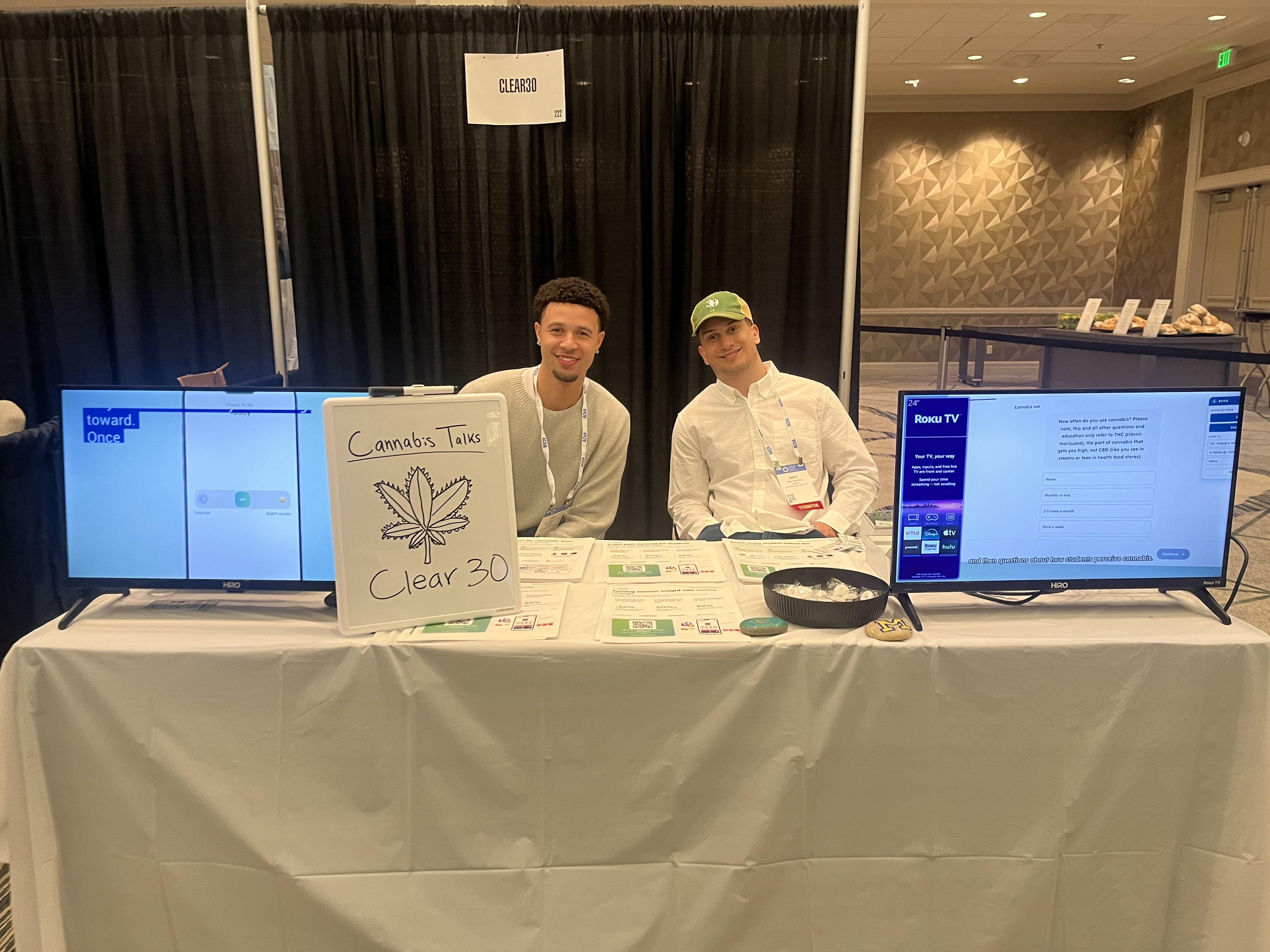
The American College Health Association Annual Meeting is where the people who run student health actually gather: directors of health services, counseling center staff, prevention and wellness leads, from hundreds of institutions. Asher Herbstman and Julian Singleton went to present Clear30’s cannabis education and screening program, and to find out whether what the team had built matched what those schools were dealing with.
Presenting it was the reason to be there. The conversations around it turned out to be the more valuable part. They talked with staff from dozens of schools across health services, counseling centers, and prevention offices, and cannabis kept surfacing on its own, without either of them raising it.
The pattern people described is not the one the field was built for. It is not occasional use of low-potency flower. It is high-potency product, used far more often, frequently daily, by students who started young enough that it is simply part of how they manage a week.
It rarely shows up alone. Staff described it arriving alongside depression and anxiety, and being used to handle both. Students are not describing a habit they enjoy so much as a coping mechanism they rely on, which is a much harder thing to address with a policy or a poster.
Staff from school after school came to the booth and said cannabis is their top priority for the coming year. That is a real shift. For most of the last decade, alcohol held that position on nearly every campus.
The scale explains the urgency. More than one in ten college-age adults meet criteria for cannabis use disorder, and more than 90 percent of them will never receive any formal treatment.1 A campus with 15,000 students is looking at well over a thousand who qualify, and a counseling center that will see almost none of them.
The most useful surprise was where technology ranked. Every school they spoke with is interested in what software can do here, but a generic AI chatbot sat at the bottom of essentially everyone's list. Nobody believes a student in a hard moment wants to talk to a bot, and staff were direct about it.
What they want is different, and two specific gaps came up again and again.
The first was being there at two in the morning. Staff described being able to help a student who is sitting in front of them, and being able to do nothing at all at the hour a student actually reaches for weed. That moment is outside office hours, outside the counseling center, and it is where they felt technology could genuinely change the outcome.
The second was routing. School after school described having real resources already in place, and students who cannot find them. Something that puts a student in contact with the support their own campus already offers, at the point they are looking for it, was one of the most requested things at the booth. Not a replacement for what they have built. A way into it.
Two further things came up repeatedly as conditions for any of that working. The first was peer voices. Students discount an authority figure telling them what cannabis does, and staff know it. The second was harm reduction. Schools have largely stopped leading with abstinence, because it ends the conversation with the students who most need to stay in it.
Those two points are the reason Clear30’s content looks the way it does. The videos in the program feature Gen Z, in their own voices and their own frame of reference, rather than a clinician explaining risk from the outside. The program does not open by asking a student to quit. It offers a break, and lets them choose what happens after it.
The team had built toward that before Colorado. Hearing it back, unprompted, from prevention directors and counseling staff at dozens of schools was the strongest confirmation they have had that it is the right approach.
The response at the booth was better than the team expected, and the conversations have continued well past the conference. Clear30 plans to exhibit again at ACHA 2027 in Philadelphia, June 1 to 5. Anyone who wants to talk before then can reach Julian Singleton at julian@clear30.org.
- 2023 National Survey on Drug Use and Health. Substance Abuse and Mental Health Services Administration. samhsa.gov/data