

FreeNo signupNo email
Will You Pass Your Drug Test?
Estimate how long THC will stay in your system based on your usage, body composition, and test type. Built on peer-reviewed research — every number is cited.
Estimate how long THC will stay in your system based on your usage, body composition, and test type. Built on peer-reviewed research — every number is cited.
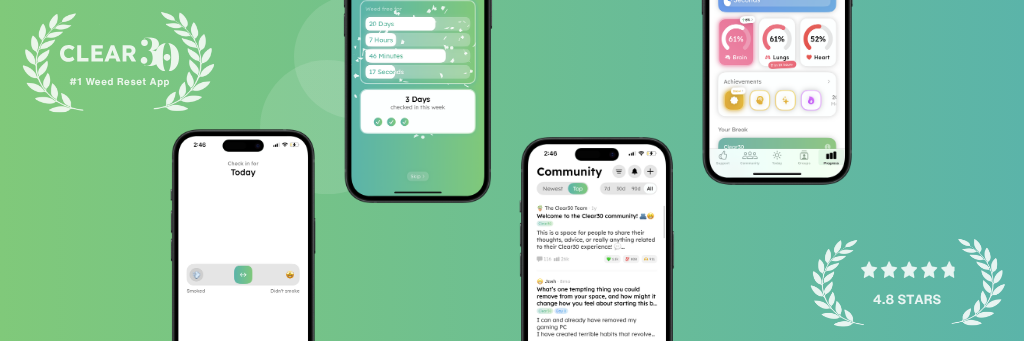
The app that clears you for good
Clear30 is the #1 science-based weed-break app. Built with clinicians and researchers, used by 150,000+ people — a private, structured 30-day program to reset your relationship with cannabis.
The honest answer is: it depends — on how often you use, how much body fat you carry, what you use (flower vs. carts, pens, dabs, or edibles), and especially the type of test. There's no single number. The calculator above returns a range based on the best peer-reviewed data we could find.
THC is unusually fat-soluble. Unlike most drugs, which leave the body in hours, THC metabolites (specifically THC-COOH) are stored in fat tissue and released slowly back into the bloodstream over days to weeks. [1] This is why chronic daily users can test positive for a month or longer, while a single-use event typically clears in under a week.
80%+ of US workplace drug tests are urine tests. They detect THC-COOH, the primary inactive metabolite. The SAMHSA federal cutoff is 50 ng/mL for the initial screen and 15 ng/mL for the confirmatory test. [5] At 50 ng/mL, Goodwin et al. (2008) reported a median clear of ~8 days for chronic users undergoing monitored abstinence, with significant individual variability. [3] At the stricter 15 ng/mL cutoff, Ellis et al. (1985) documented some chronic users taking up to 77 days to produce a clear sample. [2]
Saliva testing detects parent THC from oral deposition, not systemic metabolism. It has a short window — typically 1–24 hours for occasional users, 24–72 hours for chronic users — which is why it's used for roadside and DOT testing when “was this person using recently?” is the relevant question. [6]
Hair testing captures a ~90-day lookback because head hair grows ~1 cm per month and a 3 cm segment is typical. The catch: hair testing has substantial false-negative rates in light users, and environmental exposure can cause false positives. [9] It's rarely used in employment screening.
Blood testing for parent THC catches only recent use — 6–12 hours for occasional users, up to 24–48 hours for chronic users. [7] But chronic users can have measurable THC-COOH in blood for up to 30 days of monitored abstinence. [8]
Frequency of use is the biggest factor. The difference between a one-time user and a heavy daily user is the difference between days and a month-plus. [4]
Body composition matters mechanistically because THC stores in fat tissue. Direct human dose-response data linking BMI to urine detection days is thin, but the lipophilicity mechanism is well-established. [1] Our calculator applies a modest modifier for body composition and labels it as a modeled estimate.
Test cutoff matters more than most people realize. A 15 ng/mL confirmatory test can roughly double the detection window for chronic users compared to the 50 ng/mL screen. [2]
What you use matters because of dose per session. Carts, pens, dabs, and concentrated edibles deliver much more THC per session than flower — which means more gets stored in fat and takes longer to clear. The mechanism is plausible, but no controlled study has directly compared detection windows across product types. [11] Our calculator treats this as an optional modeled modifier.
Exercise can release stored THC back into circulation — Wong et al. (2013) measured a ~15% plasma THC bump after 35 minutes of moderate cycling. [10] The study did not directly test whether this causes urine test failures, so take it as mechanistic evidence rather than a definite rule.
No. There's no reliable way to force THC out of your system. Water loading only dilutes urine transiently — and if your sample is flagged as dilute (creatinine below 20 mg/dL or specific gravity below 1.003), the lab can reject it. [5] “Detox drinks” do the same thing: mask, not eliminate.
The only real lever is time plus abstinence. If you're serious about clearing a test — and about not repeating this cycle — Clear30's 30-day break program is built for exactly this. Structured plan, craving tools, human support.
For a standard 50 ng/mL workplace urine test, single-use clears in 2–4 days, occasional users in 3–7 days, regular users in 7–14 days, and daily users in 10–21 days. Heavy chronic users can test positive for 30–45 days and, at the stricter 15 ng/mL cutoff, a small minority have tested positive up to 77 days after last use (Ellis 1985).
Saliva (oral fluid) reflects recent use — typically 1–24 hours for occasional users and 24–72 hours for chronic daily users. Saliva is used in roadside and DOT testing because it suggests recent use rather than past use (Lee & Huestis 2014).
Hair testing has a ~90-day lookback window, but it has a substantial false-negative rate for light users and can produce false positives from environmental exposure. It is rarely used in employment screening (Huestis 2007; Taylor 2017).
Parent THC disappears from blood in 6–24 hours for occasional users. For chronic daily users, whole-blood THC can remain detectable for 24–48 hours, and THC-COOH (the metabolite) can stay detectable for up to 30 days (Schwope 2012; Karschner 2009).
Exercise has been shown to cause a modest (~15%) bump in plasma THC in regular users, likely from release of stored THC in fat tissue (Wong 2013). However, no study has directly shown that exercising before a urine test causes a failure. As a precaution, avoid intense exercise the day before a test.
Mechanistically, yes — carts, pens, dabs, and concentrated edibles deliver more THC per session than flower, which means more THC gets stored in fat tissue and takes longer to clear. However, no controlled study has directly compared detection windows across product types (ElSohly 2016 documents potency trends only). The calculator treats this as a modeled modifier, not a measured effect.
THC is highly fat-soluble and sequesters in adipose tissue (Huestis 2007). In chronic users, stored THC slowly releases back into circulation over days to weeks. Body composition is therefore mechanistically relevant, though direct human dose-response data linking BMI to urine detection days is thin. Our calculator treats it as a modeled modifier.
There's no reliable way to force THC out of your system. Water loading only dilutes urine transiently and can cause labs to flag a sample as 'dilute' (SAMHSA: creatinine <20 mg/dL, specific gravity <1.003). The only approach supported by the literature is time plus abstinence. Clear30 can help you structure the abstinence period.
Federal workplace (SAMHSA) uses a 50 ng/mL initial immunoassay screen and 15 ng/mL GC-MS confirmatory for THC-COOH. Private employers sometimes use 20 ng/mL or 100 ng/mL. If you don't know your test's cutoff, assume 50 ng/mL — it's the most common.
For a true first-time or one-time user, a single hit of weed typically clears the standard 50 ng/mL urine cutoff within 2–4 days. Blood is usually clear within 12–24 hours, and saliva within 12 hours. Detection time depends almost entirely on your prior use history — if you smoked once last week and once today, your detection window resembles an occasional user, not a one-time user. If your previous use was months ago, treat yourself as a single-use case.
Edibles produce the same THC metabolite (THC-COOH) as smoking, so urine detection windows are roughly the same: 2–4 days for occasional use, 7–14 days for regular use, up to 30+ days for chronic daily use. Edibles do clear from blood and saliva slightly slower than smoking because absorption is gradual through the digestive tract. The dose matters more than the format — a 100 mg edible loads more THC into fat tissue than a single bowl of flower (Huestis 2007).
Delta-8-THC and HHC metabolize into the same THC-COOH metabolite that standard urine drug tests detect. Most workplace immunoassays cannot distinguish Delta-8, Delta-9, or HHC from each other — they all trigger a positive result. Detection windows are therefore similar to Delta-9 (regular weed): 2–4 days for occasional use, up to 30+ days for chronic users. "Hemp-derived" or "federally legal" labeling does not change drug test results.
Pure CBD does not trigger standard drug tests, which screen for THC-COOH (the THC metabolite). However, many CBD products labeled "broad-spectrum," "full-spectrum," or "hemp-derived" contain trace THC — legally up to 0.3% by weight. Daily use of these products has been documented to cause failed drug tests. CBD isolate is the only formulation considered safe for people who are drug-tested.
Most detox drinks do not chemically eliminate THC from your body — THC is fat-soluble and cleared through hepatic metabolism over time. What detox drinks can do is temporarily dilute urine: heavy hydration drops THC-COOH concentration below the cutoff for a few hours. The trade-off is that labs are trained to flag dilute samples (creatinine <20 mg/dL or specific gravity <1.003) as invalid, and many will require a retest. The only methods supported by peer-reviewed evidence are time and abstinence. If your test is more than 30 days out and you are quitting anyway, Clear30 can help structure the break.
Honestly, very little. The science is clear: THC-COOH cannot be reliably eliminated from urine in under 24 hours by drinking water, exercising, taking niacin, or using detox products. If you're an occasional user who smoked once recently, you may already test below the 50 ng/mL cutoff — running the calculator with your specific use history will give a realistic estimate. If you're a regular or daily user, a 24-hour window is too short. Your remaining options are limited to delaying the test if possible, hydrating moderately the day-of (not extreme dilution, which gets flagged), or accepting the result.
A 30-day break is what resets your body. Clear30 gives you the structure: daily plan, craving tools, human peer support, and a community of 150,000+ people doing the same reset.
Download Clear30 →